
Emma
If you already track your spending with Emma, you know where your money goes each month. Doughsense picks up a different question: what to do with what you are saving.
Emma is a mobile-first spending tracker and subscription manager with strong Open Banking integration in the UK. Doughsense is a financial planning tool focused on projections, scenario modelling, and portfolio management. They complement each other well because they work at different time horizons: Emma looks backward at your recent spending, Doughsense looks forward across years and decades.
At a Glance
| Feature | Doughsense | Emma |
|---|---|---|
| Bank feeds | Yes (UK open banking, on Plus tier) | Yes (UK, US, Canada) |
| Spending tracking | No | Yes (categorised transactions) |
| Subscription management | No | Yes (detect and cancel) |
| Cashback | No | Yes |
| Financial projections | Yes (monthly to decades) | No |
| Monte Carlo simulations | Yes (97 years of historical market returns, 1928-2024) | No |
| Financial health metrics | 12 metrics | No |
| Milestone tracking | Yes (with projected dates) | No |
| Portfolio management | Yes (assets, liabilities, investments) | Limited (balance view) |
| Multi-currency | Yes | Limited |
| Mobile app | Yes (iOS and Android) | Yes (mobile-first) |
| AI-assisted onboarding (Plus) | Yes | No |
Which Is Right for You?
Choose Emma if you want a mobile spending tracker with smart bank integrations. Emma excels at showing you where your money goes each month, catching forgotten subscriptions, and offering cashback on purchases. Its Open Banking integration in the UK is seamless, and features like rent reporting add practical value. Emma's mobile apps are polished and well-designed.
Choose Doughsense if you already know where your money goes and the next question is "where is it heading?". Emma shows your recent spending; Doughsense projects your entire financial future. Set milestones for what matters, like paying off your mortgage, hitting a savings target, or reaching financial independence, and see projected dates for each one. Monte Carlo simulations then show in what percentage of real market scenarios you hit each milestone on schedule, and whether you get there eventually even if markets underperform.
If you are a UK user, Doughsense and Emma are a natural pair. Emma's Open Banking integration tracks your day-to-day spending; Doughsense models your pensions, ISAs, and UK tax allowances into a long-term plan. Where Emma helps you spend less, Doughsense helps you understand whether what you are saving is enough. It understands UK financial structures natively: pension drawdown, tax allowances, and GBP as default.
12 financial health metrics, covering savings rate, FI progress, cash flow, debt ratios and more, explain each concept in plain English, so you learn as you plan. Guided setup builds your plan in minutes, with AI-assisted onboarding on the Plus tier. For deeper projection tools, see our ProjectionLab comparison.
See It in Action
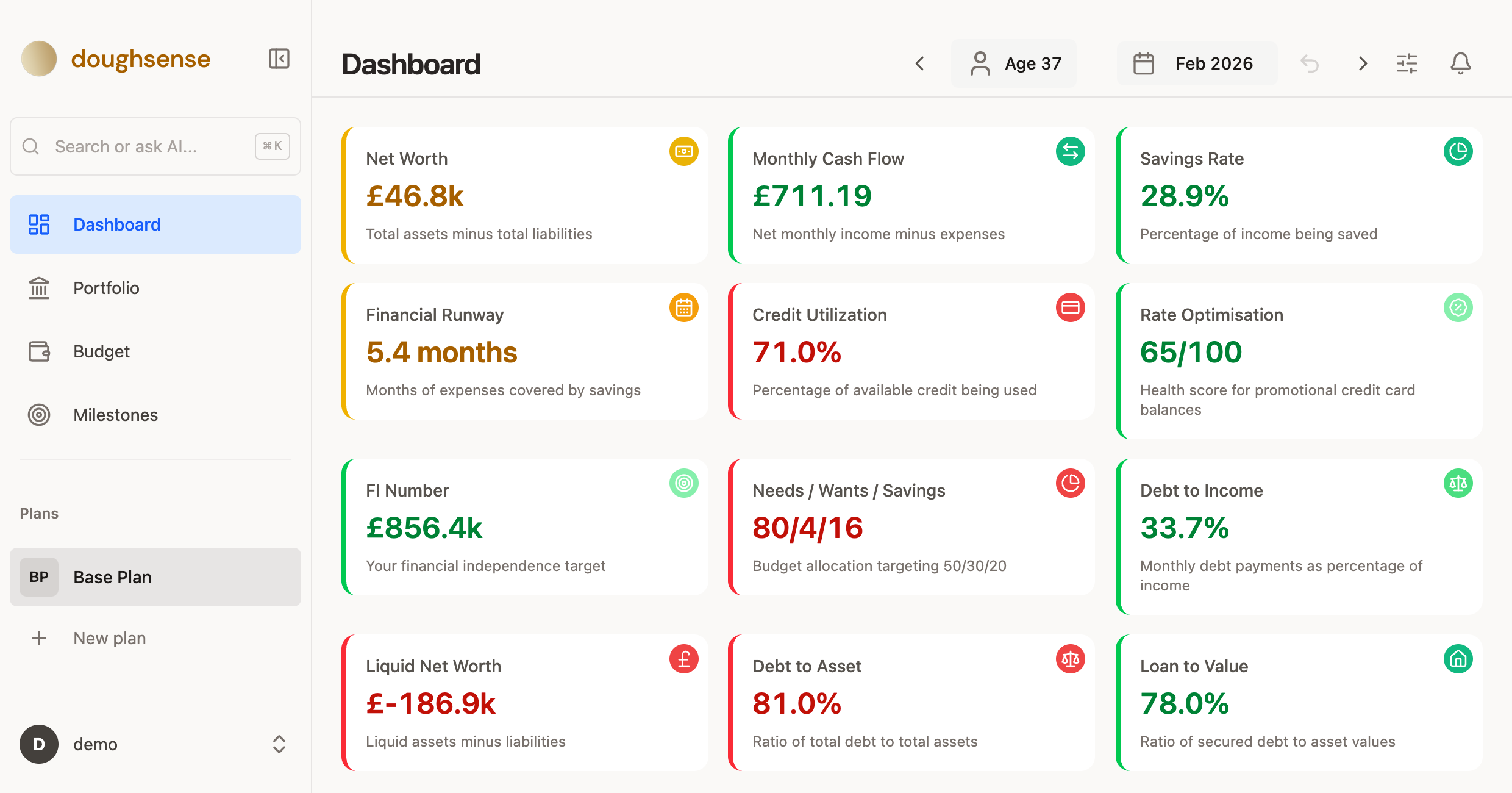
Doughsense financial health dashboard showing 12 metrics with health scores
Pricing
Emma offers a free plan with basic spending tracking and two bank feeds, and paid plans from £4.99 per month or £41.99 per year (check their pricing page for current rates). Doughsense is free forever with manual data, and its Plus tier adds UK bank feeds and a self-maintaining plan for £10 per month or £80 per year, with a 14-day Plus trial that starts when you connect your bank and no card required. Both have a free tier for different jobs: Emma's for spending tracking, Doughsense's for planning your financial future.
Frequently Asked Questions
Does Doughsense track spending?
Not the way Emma does. Doughsense can connect to your bank on the Plus tier to keep balances current, but it does not categorise individual transactions or track spending by category. It is a financial planning tool that models your future based on your income, expenses, assets, and liabilities. If you want to see where last month's money went, Emma is the better choice. If you want to see where your money is heading over the next 10 years, Doughsense is built for that.
Is Emma or Doughsense better for financial planning?
Doughsense is purpose-built for financial planning. It runs Monte Carlo simulations, tracks 12 financial health metrics, and projects milestone dates for goals like financial independence or mortgage payoff. Emma focuses on spending tracking, subscription management, and cashback. They solve different problems at different time horizons.
Can I use Emma and Doughsense together?
Yes, and they cover different ground without much overlap. Emma tracks your day-to-day spending, catches forgotten subscriptions, and gives you cashback on purchases. Doughsense projects your financial future and tracks your progress toward long-term goals. While Emma's Open Banking integration is strongest in the UK, Doughsense is built in the UK but works anywhere: custom tax schedules and multi-currency support mean your plan stays accurate wherever you are based. If you already use Emma and want to start planning ahead, Doughsense covers that ground.
How long does Doughsense take to set up?
Most users are set up within 10 to 15 minutes. Guided setup walks you through adding your accounts, income, and expenses, and on the Plus tier, AI-assisted onboarding and bank feeds skip entering balances by hand. You can start entirely with manual data for free. If you know your account balances and rough monthly income and expenses, you can have a complete financial plan running in under 15 minutes.
Can I try Doughsense before committing?
Yes. Doughsense is free to start with manual data, no card required, and a 14-day Plus trial begins when you connect your bank. That gives you enough time to set up your plan and explore the projections, metrics, and scenario modelling before deciding whether to subscribe.
Competitor details were accurate as of July 2026. Features and pricing may change - visit their site for the latest. Spot something outdated? Let us know.
Ready to plan ahead?
See where your money is heading over the next decade. Free to start, no card; a 14-day Plus trial begins when you connect your bank.
Request early access